A knife can feel dull long before it is truly dull. Often, the steel at the very edge has simply bent out of line through normal chopping, slicing, and contact with the wrong cutting surface. Knowing how to maintain knife alignment keeps a quality blade controlled, clean-cutting, and ready for daily work.
That distinction matters. Sharpening removes metal to create a new edge. Honing realigns the existing edge. Treat every knife problem as a sharpening problem, and you remove more steel than necessary. Maintain alignment well, and sharpening becomes an occasional reset instead of a constant repair.
What Knife Alignment Actually Means
A sharp knife edge is extraordinarily thin. Under magnification, it is not a broad wedge but a fine apex. With use, that apex can roll slightly to one side. The knife may still look flawless, yet it will skid on a tomato skin, crush herbs, or require too much force through an onion.
Knife alignment is the position of that microscopic edge. A honing rod, honing plate, or other fine honing surface gently brings the rolled edge back toward center. It does not replace the edge. It restores its working geometry.
This is why a knife that feels dull can sometimes return to clean performance in a minute. If honing makes no difference, the edge is likely worn away rather than merely misaligned. That is when true sharpening is warranted.
Hone Before the Edge Feels Gone
The best time to hone is before performance drops noticeably. For a knife used most days, a few light passes before a larger prep session is usually enough. A knife used once or twice a week may need honing less often. There is no universal calendar because steel hardness, edge angle, cutting habits, and surface all change the equation.
Do not wait until the blade tears food. A misaligned edge invites more pressure, and more pressure makes prep less precise and less safe. A controlled blade should enter food with minimal resistance.
Use the Right Honing Tool
Not every rod performs the same job. A smooth steel rod primarily realigns a rolled edge. A ceramic rod offers a finer abrasive action and can remove a small amount of material while refining the edge. Diamond-coated rods are more aggressive and should be used sparingly. They can be useful, but daily use may shorten the life of a fine knife.
For most premium kitchen knives, smooth steel or fine ceramic is the right standard. The goal is maintenance, not metal removal.
If your knife manufacturer specifies a particular honing method, follow it. Very hard Japanese-style blades, for example, may not respond to a traditional heavy steel in the same way as softer Western blades. A fine ceramic rod or whetstone maintenance routine is often the better fit.
How to Hone a Knife Without Damaging It
Technique matters more than speed. Fast, theatrical strokes look impressive, but they create inconsistent angles and unnecessary risk. Set the rod vertically with its tip planted securely on a folded towel or stable counter. Hold the knife at the edge angle it was sharpened to - often about 15 to 20 degrees per side.
Starting at the heel of the blade, draw the edge down and across the rod in one smooth, light motion, finishing at the tip. Alternate sides. Five to eight gentle passes per side are usually enough for routine alignment.
Pressure should be minimal. Think of guiding the edge, not grinding it. Pressing harder does not improve alignment. It can deform a delicate apex, scratch the blade, or remove material from an abrasive rod.
After honing, wipe the blade clean and test it on a sheet of paper or a ripe tomato. A properly aligned knife should cut with a clean, direct bite. If it still slips, use a sharper diagnostic: does the blade feel uniformly weak, or is there one rough section? Uniform weakness often means sharpening is due. A rough spot may indicate a chip or localized damage that needs more deliberate attention.
Your Cutting Surface Determines How Long Alignment Lasts
A knife does not lose alignment only through food. It loses alignment through impact. Every time the edge meets a board, the board either gives the edge a reasonable landing surface or punishes it.
Glass, stone, ceramic, and hard composite boards are hostile to knife edges. They may look polished, clean easily, or match a countertop, but they provide almost no forgiveness at the point of impact. Hard plastic can also be problematic over time, especially when deeply scarred, warped, or loaded with abrasive wear.
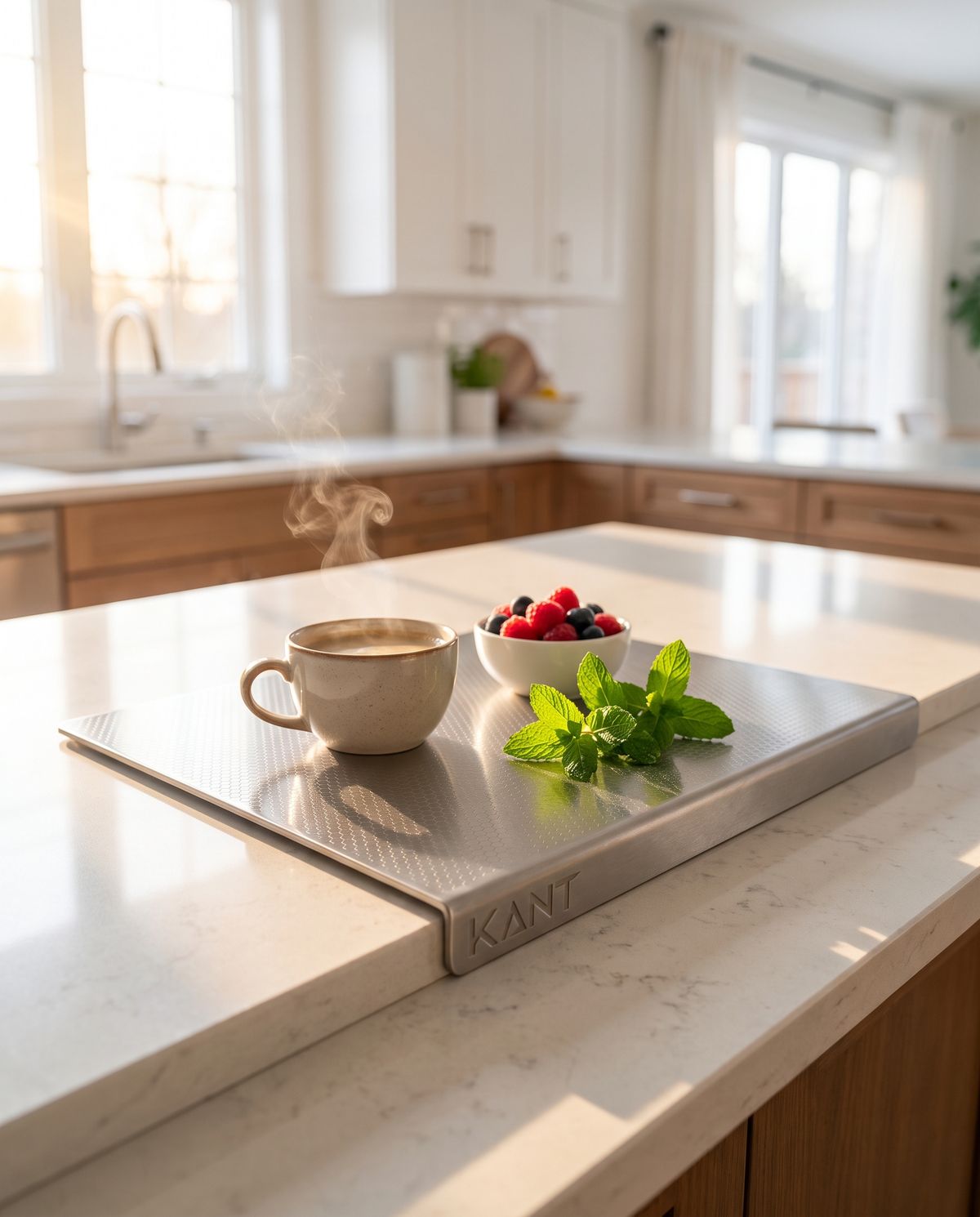
Wood has long been favored because it has some give, though it requires care and remains porous. The right stainless steel prep surface is different from the hard, slick metal many cooks imagine. KANT™ Surface Technology uses micro-textured 304 medical-grade steel engineered to respect the blade edge while delivering a non-porous, microplastic-free prep surface.
The lesson is simple: knife alignment is not preserved by honing alone. It is preserved by making the board part of the knife-care system. A premium knife on the wrong board is a short-lived advantage.
Cut With Control, Not Force
Good cutting habits protect alignment between honing sessions. Use a forward-and-down slicing motion where appropriate rather than driving the edge straight down with force. Let a sharp knife work. Twisting the blade through dense food, prying apart frozen ingredients, or chopping directly into bones will roll or chip even excellent steel.
Use the right tool for the task. A chef's knife is not a cleaver. A thin slicer is not a squash splitter. For hard winter squash, stabilize the ingredient and use a suitable heavy knife with controlled pressure. For herbs and vegetables, keep the tip or midsection in contact with the board as needed and avoid scraping food aside with the cutting edge.
Instead, turn the knife over and use the spine to move ingredients. That one habit prevents needless edge contact with the board.
Store Knives So Edges Do Not Collide
The edge can lose alignment in a drawer before it ever reaches the cutting board. Loose storage allows knives to knock against other utensils, creating tiny rolls, dents, and chips. Do not toss a sharp blade into a catch-all drawer, even if it has a sheath nearby.
A magnetic strip, individual drawer slots, blade guards, or a quality knife block all work when used correctly. The best option depends on your kitchen and the number of knives you own. Magnetic storage keeps blades visible and dry, but only if you place and remove each knife with the spine touching first. A drawer insert protects edges from contact, but it should be kept clean and dry.
Never store a knife wet. Water left along the edge can contribute to staining or corrosion, particularly on high-carbon steel. Dry the blade fully after washing, including the heel and handle junction.
Clean Knives Like Precision Tools
Dishwashers are rough on knives. High heat, prolonged moisture, harsh detergent, and contact with other utensils all work against edge life and finish. Hand-wash promptly with mild soap, rinse, and dry immediately.
Avoid leaving a knife in the sink. It is a safety issue first, but it is also hard on the edge. A blade can strike the sink basin, get buried under cookware, or sit in moisture for far too long.
Keep the honing tool clean as well. Ceramic rods can collect gray metal residue, and diamond rods can hold debris that makes their action less predictable. Wipe them down according to the manufacturer’s guidance so each pass stays consistent.
Know When Honing Is No Longer Enough
Honing cannot restore steel that is gone. If the knife does not improve after careful, light honing, it is time for sharpening. Other signs include visible chips, a flat reflective spot along the edge, or a blade that will not cut paper cleanly anywhere along its length.
How often you sharpen depends on use and maintenance. A well-made knife used on a blade-respecting surface may need professional sharpening or whetstone work only a few times a year, sometimes less. A knife used hard on glass or stone may need attention far more often.
Sharpening is not a failure. It is the planned renewal of a tool designed to work for decades. The goal is simply to make every sharpening count by preserving the edge between sessions.
Treat your knife like the precision instrument it is. Hone lightly, cut on a surface worthy of the blade, wash by hand, and store it without impact. The reward is not just a sharper knife. It is quieter, cleaner, more confident work at the board.